Mit „Lärm“ nach Portugal
Aerowaves Spring Forward 2026 stellt die ausgewählten Produktionen vor
By Polina Bulat
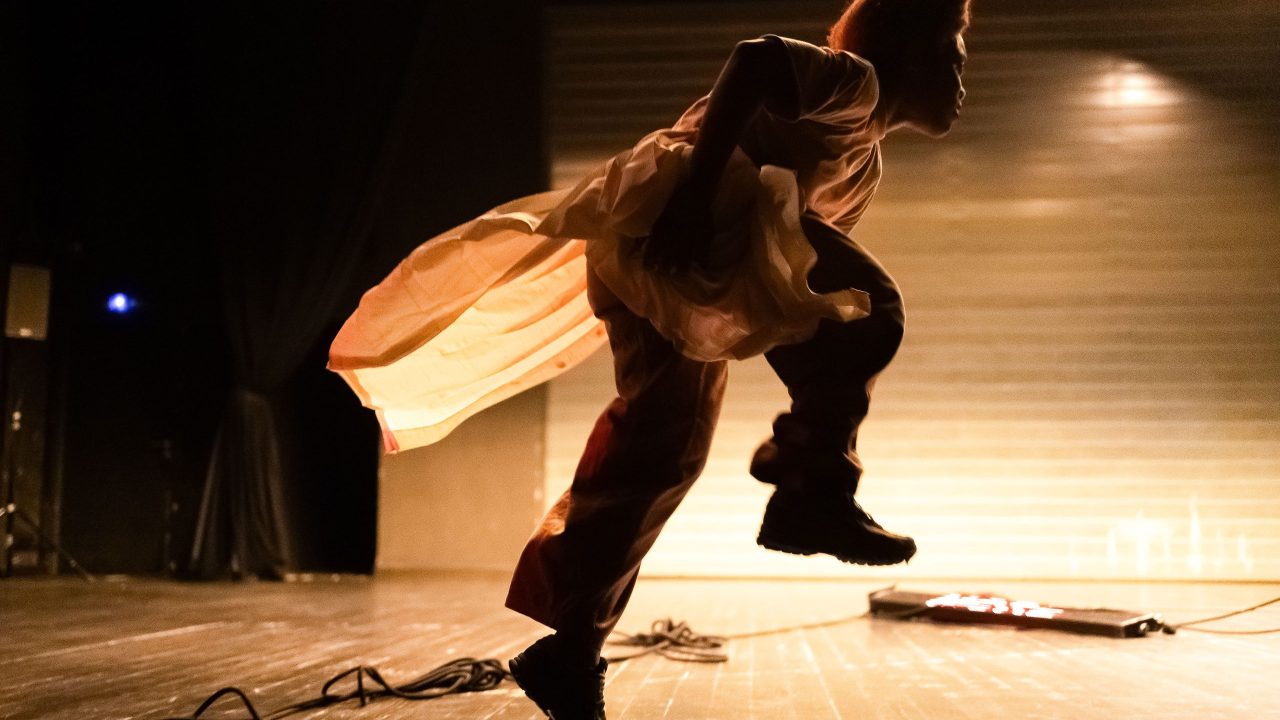
Johana Malédon sits in a lit corner of the stage, trying to tame her thick curly hair with a handful of pins. Her process is intentional and sharp, yet subtle. She crosses the stage on her knees, stops, turns, sits and looks into the faces of those seated in the front rows. While her poses remain calm, fluidly transitioning into one another, those nearby can catch the small gestures of her feet: a point, a contraction, signals of unease, a trembling desire for movement, or an attempt to communicate something unspoken.
Malédon changes her pants for a long white skirt, adds and tightens a stiff corset that creates a Victorian-like silhouette, then puts the pants back on again, shaking her head and freeing her hair from the pins, collecting them only to spit them out through her mouth. Her companion on the dimly lit stage is a simple monitor, the kind corner shops often use to signal they are open. This one signals openness too, creating the atmosphere of a liminal space in which everything significant unfolds under its invitation.
As her body seamlessly transitions from one image to another, text rushes across the screen in several languages alongside streams of numbers. They declare nothing directly, yet reveal something we might call memory, or even identity: fragments of subconsciousness responding to the external gaze.
(titre provisoire) is the name of Malédon’s solo, premiered in 2025 and presented at this year’s Spring Forward festival as part of the Aerowaves Twenty26 selection. This edition of the festival took place in Guimarães, a European Green Capital and a place often described as “where Portugal was born.” For 30 years, Aerowaves has functioned as an infrastructure of succession and development within contemporary dance, sustaining the continuity of the field through long-term relationships between emerging and experienced talent across generations and geographies. In a landscape increasingly shaped by acceleration and competition, such infrastructures of support become remarkable forms of cultural maintenance.
Malédon’s homeland, French Guiana, is 96% covered by the Amazon rainforest, which constitutes the EU’s largest national park, bordering Brazil. The region, tossed between multiple European colonizers attempting to determine what to do with the land while devastating its Indigenous populations, ultimately became a French territory. A former prison colony, sugar colony, refuge, and a site of both legal and extensive illegal gold mining alongside a space center, the area situated more than 7000 km from the metropole can be considered an embodiment of ever-flowing, rhizomatic negotiation.
“I’m French Guianese with all the complicities,” says Johana Malédon when I ask her how she identifies herself. “And I’m not angry.”
Today, the EU invests billions into reversing results of extractive systems: combating illegal gold mining in French Guiana, which has led to mercury pollution in the water, not to mention deforestation. The consequences of infrastructures built on conquest rather than continuity through negotiation are present on every level of Western culture, exploiting bodies as much as land.
acceleration, exhaustion, repair
“In French Guiana, but also in the Caribbean, there was marronage: enslaved people used passiveness as a form of resistance. To preserve their lives, they worked slower and slower and sometimes disappeared into the forest,” she tells me. “I found this very interesting, exploring what it means to be less productive and less speedy, to get less invested into things. In my career I was called a bulldozer for years. And I knew that sometimes people hired me because I had this energy, that I could always be angry. And I was happy for that, because I was the one taking space. But I’m tired of that. I’m not only that. Maybe I need to build my own space to explore something else.”
Across these different contexts, from ecological restoration to artistic labor, the same cycle repeatedly appears: acceleration, exhaustion, repair. Ecosystems devastated through extraction later become objects of restoration programs. Burnout produced through permanent productivity generates parallel industries of recovery. Cultural infrastructures attempt to reconcile sustainability with systems still dependent on mobility, growth and constant visibility.
Spring Forward’s host, Guimarães, a relatively small city of around 52 000 inhabitants, is itself committed to the concept of a “One Planet City,” where local production and consumption are negotiated according to the ecological limits of the territory. Johana Malédon’s work seems to operate through a similar logic.
The images that (titre provisoire) offers continuously evade stable interpretation. There is an active attention to conditions rather than outcomes, a movement alongside change rather than toward resolution, just as the streams of text and numbers crossing the monitor never stabilize into language. The work examines what is already there, introducing the figure of the artist, who observes and is being observed, to a field of relations with history and others.
In the quietude of Malédon’s solo and the structure of the Aerowaves network there might be a blueprint for the capacity to remain, negotiating the pressure to produce. This is mirrored in how Aerowaves attempts to function: acting as a buffer that prioritizes the continuity of the artistic ecosystem, which is reflected in the enduring careers of Spring Forward alumni like Mette Ingvartsen, Christos Papadopoulos and Marco da Silva Ferreira among many others.
The labor of maintenance remains heavy. At one point during her performance the “corner shop” monitor falls down on stage. To finish the work, she takes long and heavy cables in her hands and silently drags it away. No statement was left on stage, only the image of a body continuing to move together with the weight into the dark while the light remains on.
Noch keine Beiträge
basierend auf den Schlüsselwörtern
Bitte anmelden um Kommentare zu schreiben