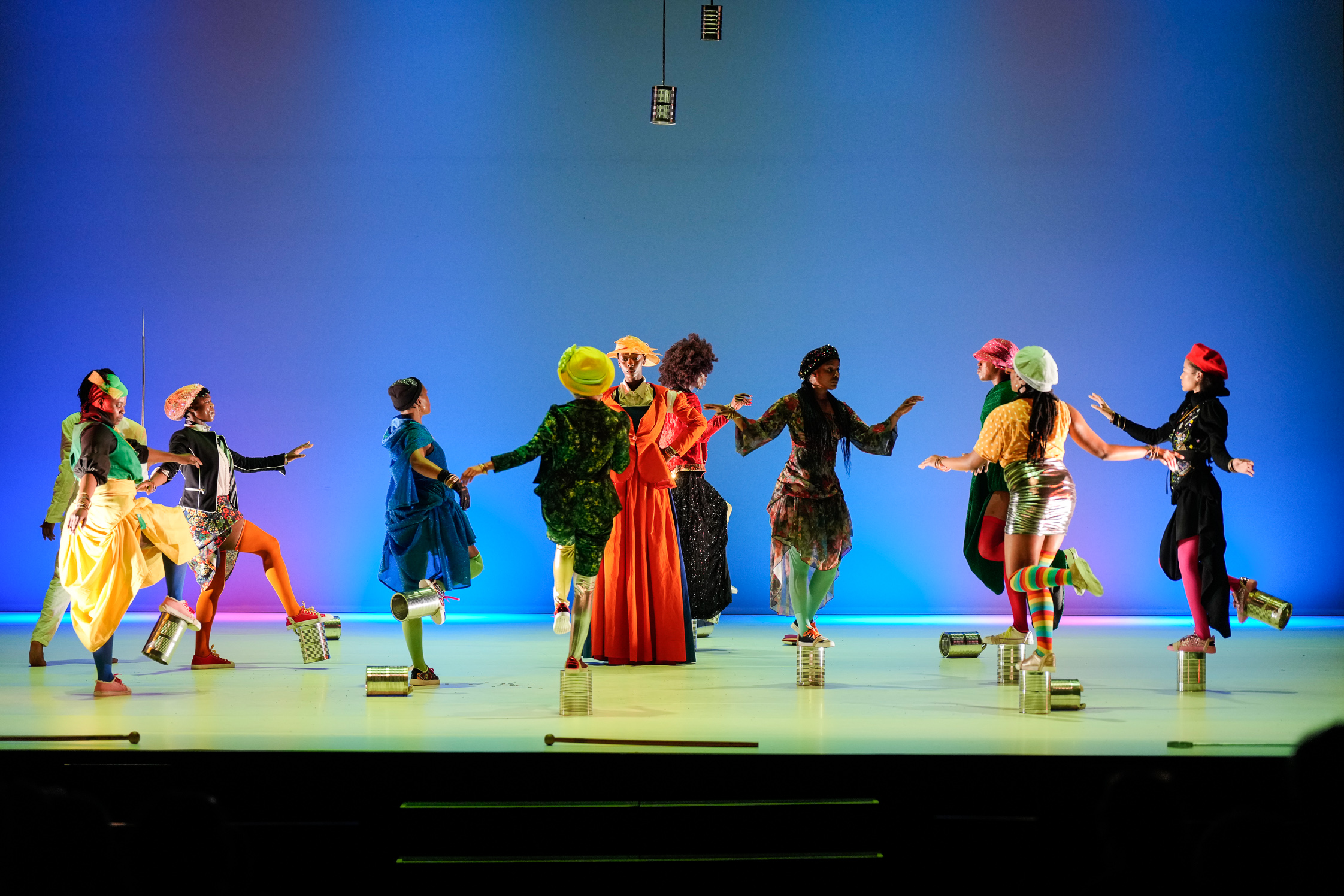
„The Herd/Less“ by Mamela Nyamza

The Good, the Bad and the Timeless

Biennale Danza 2026 at Venice

It’s worth taking a closer look at the spots between major names like Emanuel Gat and John Neumeier, gracing the Venice festival this time. The spectrum ranges from earsplitting noises to an actual, yawdropping slowing down of time.

Venice, 29/07/2026

Time does not exist. It sure doesn’t in Venice. That’s what you get convinced of instantly upon arriving there. What might feel like the most worn out commonplace is this year’s motto of Biennale Danza. Besides, when speaking of the perception of performing arts, they always make time stop, anyway. And indeed Biennale Danza has a spellbinding work in its programme that manages to toy with time, manipulating its „progress“ in a simple and yet astonishing way, just as simple as the title „Tempo“ (engl. time) itself is. But this masterpiece by Kalle Nio and Ferndando Melo is set to be the final icing of this cake or text respectively.


The European Premiere of „The Herd/Less“, choreographed by Mamela Nyamza and performed by her ensemble, took the dance style of gumboot (derived from the term rubber boots) to a whole new level, rough-handling the audience’s nerves in an intricate manner. Drawing on the manner of coal miners stomping in their rubber boots, Nyamza „elevates“ the dancers by placing them on tin cans fixed to their feet. The sheer noise of their steps, even reinforced by the harsh tones of a whistle, is both overwhelming and mesmerizing. This stomping herd continuously transforms between what seems to be animals (elephants?) and human being, trying to keep things together, literally. Surprisingly those, who dare to leave this herd, striving for individuality, are not being punished by their fellows, let alone they’d get cast out. Instead they are granted the space they need to develop. This event is set in a somewhat glamorous frame with the colourful costumes seemingly covering the last 100 years of fashion, including what seems to be a twinkle of postcolonial touch.

What might seem undercomplex on that part, can be read as mere longing for the simple right of personal freedom, but also peace: An image that gains more of significance as the piece unfolds, is the upright balancing of a speer on the open hand, just like carefully handling the delicate state of peace as the absence of war. This leaves the audience not just with ringing ears, but also with a decent amount of food for thoughts.


And yet, not all the works presented at Biennale Danza are this complex and convincing at the same time. There’s even an overambitious approach as in „Láhppon/Lost“ by Elle Sofe Sara and Hlín Diego Hjálmarsdóttir. Inspired by Sámi culture and tradition, the piece directs almost 20 dancers of the Norwegian National Ballet through a (historic) story of forced assimilation and rebellion against it. This aspect is to be understood fairly easily, while the meaning of the constant moving of huge stage props remains somewhat vague. Another scene might be an allusion to corona with huge red, fuzzy props like virus, seemingly almost killing everyone. 

There’s a constant hustle and bustle on stage with dancers coming and leaving, harsh breaks between the scenes and no clear dramaturgy. 


That in some way connects to Oli Mathiesen’s „Just between me and Jesus“. Along with Andrea Salustri, he is winner of the national call for a new choreography for this year’s festival. Mathiesen tries to marry the rave atmosphere of a club with the spirit of a Holy Mass, but the dancers don’t seem to be conveying this message. There’s nothing but posing and some lame attempt to provoke („urinating“ into one of the dancers mouth), the dancers even don’t seem to be professionally trained. They still have a long way to go before they are granted access to the Berghain. 

Almost as some sort of contrast to that rage of Prodigy’s hymn „firestarter“, Salustri sets the dripping sound of a single water drop and the iridescent flirring of light. His work „invisible“ basically sets aside any sort of performance, just to focus on light, sound and the movement of stage fog. This is lovely to behold, but so underwhelming, it allows for time to ponder on the question how this might have found its way into a performing festival. It sure does involve several sorts of „movement“, but would have been more convincing when framed as a first theatre experience for children.


Thank God, Omar Rajeh is still on the side of what’s commonly referred to as dance. His piece „Dance People“, which has been travelling Europe for some time now, saw its Italian premiere outside Venice in Mestre. For this Biennale Danza leaves town for the first time, assumingly to sort of decentralize the festival and to further involve local audiences. 

Having been part of this work, literally, it seems obvious that the title alludes to the phrase Pina Bausch so often used: „Tanzt, tanzt, sonst sind wir verloren!“ (engl. „Dance, dance, otherwise we’re lost!“). The Beirut choreographer together with the dancers of his ensemble Maqamat collectively infuse the audience who join the spectacle on Piazzale Divisione Acqui under the open night sky. They make everyone dance, but not just for the sake of it. Rajeh always involves some sort of social message. Here he celebrates the freedom of democracy and diversity, placing it right next to the menace of war and terror, thereby revealing its fragile nature, just as Mamela Nyamza does in her piece. 


This all makes time past most blissfully, contributing to la dolce vita in an almost clichéd way. The real masters of time, however, turn out to be Kalle Nio and Ferndando Melo. Their work „Tempo“ is what might be called classical performance theatre with some sprinkles of dance in it. In a grey, vaguely lit room three performers unfold a loose selection of scenes that convey nothing but images and tiny fragments of incidents. Although there’s no story to it, they grasp the audience from the very first moment. 

Involving stage illusions they manage to slow down time, arresting one of the performers in mid air, both inconceivable and enchanting. Chairs move on their own, soothingly, dreamlike. 

The performers make time repeat itself with the same scene over and over again, just separated from each other by quick blackouts like the blink of an eye. They even speed time up, without ever leaving the audience behind. 

That approach in its poetic, tranquil nature reminds of the performances by Dimitris Papaioannou, but without a hint at anything grotesque or absurd. Strangely enough this exudes nothing but beauty. If time keeps being this reassuring, there’s nothing to be afraid of. And simple as it might seem, they are right: Time does not exist. What a surprise.


Kommentare

Noch keine Beiträge

Ähnliche Artikel

basierend auf den Schlüsselwörtern