Geballte Frauenpower
Uraufführung von Doris Uhlichs „Sonne“ am Festspielhaus St. Pölten & „Ophelia‘s Got Talent“ von Florentina Holzinger als Gastspiel am Wiener Volkstheater im Rahmen der Choreographic Platform Austria
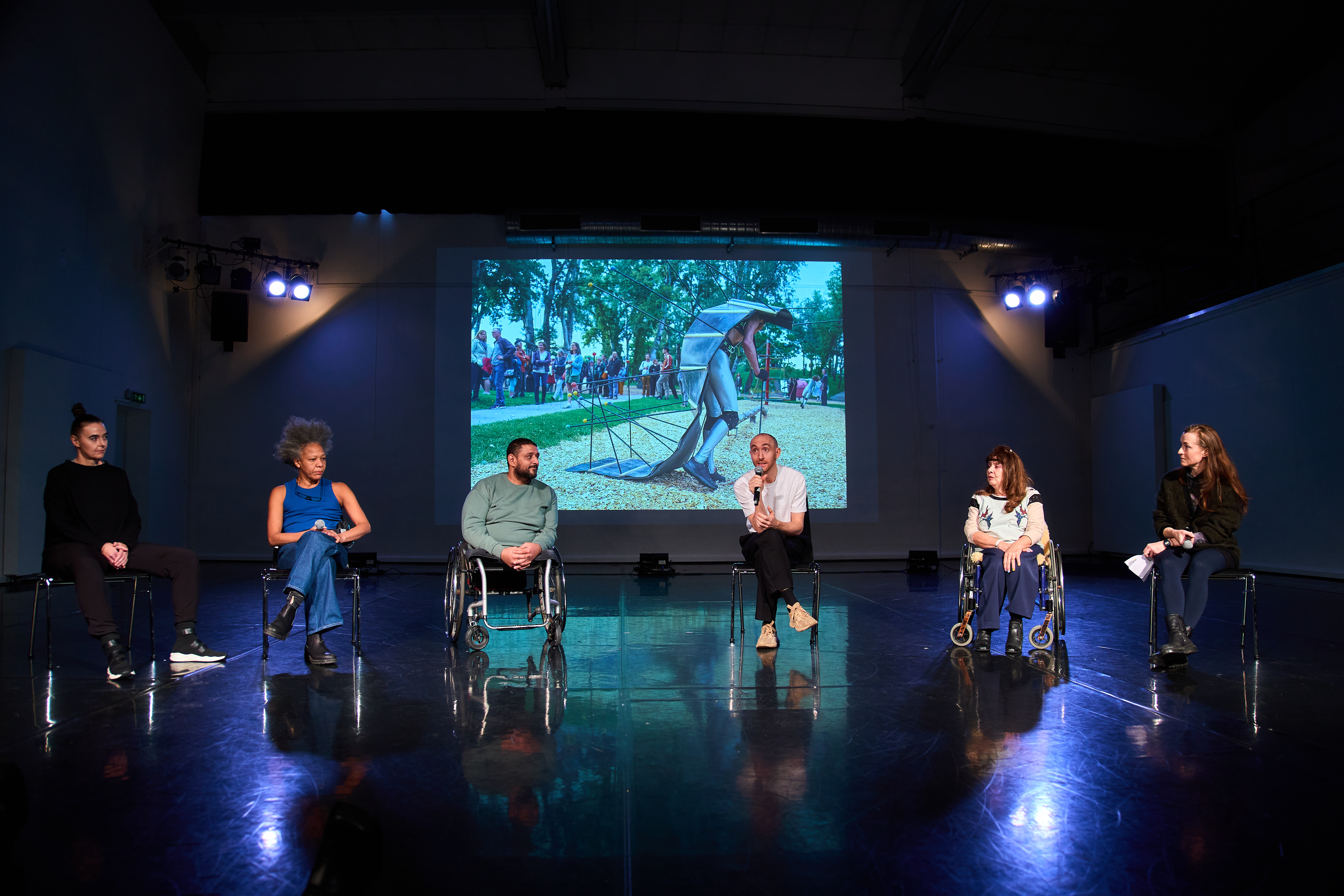
Video presentation and talk of "melancholic ground" by Doris Uhlich at Choreographic Platform Austria
By Miriam Stuefer
Who can use a playground? What bodies are excluded? In what ways can a playground be used? And how do we, as adults, reflect on our childhood experiences in playgrounds? These are questions Doris Uhlich explores in her piece melancholic ground, where the cast is made up of people of all abilities, all bodies and all ages. Ironically, it is the only piece that, due to organisational constraints, could not be performed at the CPA.
Doris Uhlich is well-known for her work on diversity, in locations, themes and performers. She has worked on stages and site-specific, worked with professional dancers and non-professionals, disabled people and able-bodied people, people who are perceived as belonging on the stage, and those who are not. In her oeuvre, she gives space and a stage to those who are usually excluded. She challenges beauty standards and finds physical inscriptions on bodies important.
The site-specific piece melancholic ground, set in a playground, can be adapted to different playgrounds and sizes. As long as people with wheelchairs can enter the space. Doris Uhlich explores how places impact our bodies, even if we do not realise it. The playground is a place of joy and laughter, of social encounters and competitions, but it is also a place of exclusion. Playground equipment is made by adults for children, and the design reveals a lot about our expectations. Much of the equipment is normative; it works with balance and imbalance and tries to make people fit.
Doris Uhlich gave a short presentation about melancholic ground followed by a 12-minute video of the 2023 performance at the Wiener Festwochen. And an interview with four of the original cast members: Hugo Le Brigand, Adil Embaby, Moravia Naranjo, and Vera Rosner.
In the video, we see people slowly sliding down a slide, stacking themselves like silver pearls on a string. We see people using their wheelchairs as a playmate to balance equipment. The performers experiment with the playground and its equipment to discover new ways of interacting with them. They reverse functions and create new ones with the existing material. Movements of the equipment are taken over by the performers. The rocking motion of the equipment is, for instance, mirrored by performers to such extremes that they nearly fall over. They work with the distance to the objects and the intensity of the movements.
Throughout, a sense of melancholy is ever-present. The movements are slow and sometimes static, with people hanging or lying in the equipment like stuffed animals forgotten in mid-play. The difficulty of wheelchairs moving through wooden chips and solitary “play” further emphasises the melancholy.
As the performance progresses, the performers start to explore moving each other to the point that the other body becomes an object, for example, when Hugo Le Brigand bounces a different performer on a trampoline as if it was a ball, and they play jump rope with a person as the rope. This is taken to the extreme when the performers transform themselves into forms between human and plaything. Adil Embaby talks about spider legs on his wheelchair, which made movement harder but felt empowering. Also, Moravia Naranjo emphasizes the joy she felt in putting the playground on her body and being able to play with herself. The pride and happiness only becomes visible through the interview as visible joy would undermine the melancholy of the piece.
During the interview (moderated by Julia Schwarzbach), the audience gains insight into the experiences of the performers and how they created the piece. Over the course of a few weeks, they experimented on the playground from 5 to 9 pm. During the first few hours, they shared the playground with children, whom they observed and who also observed them. The children gave them inspiration in movement qualities, such as sudden bursts of joy and energy.
During the performance, the playground was not “closed”, so children were playing on the same grounds. Vera Rosner laughingly remembers the children who did not understand her joy of being in the playground wearing a huge bear head and moving her feet to the music. One year later, some of the performers came back and were greeted by the children with “Hello Raven”, remembering the oversized raven head balancing on the body of a performer. Even though the performance is now finished, their ghosts will haunt the playground for a long time still.
Dieser Text entstand im Rahmen einer Kooperation von tanznetz mit Studierenden der Paris Lodron Universität in Salzburg unter der Leitung von Dr. Miriam Althammer und der Choreographic Platform Austria.
Noch keine Beiträge
basierend auf den Schlüsselwörtern
Bitte anmelden um Kommentare zu schreiben