Avatare und Masken
Marlene Monteiro Freitas' „Nôt“ und Clara Fureys „Unarmored“ bei Tanz im August
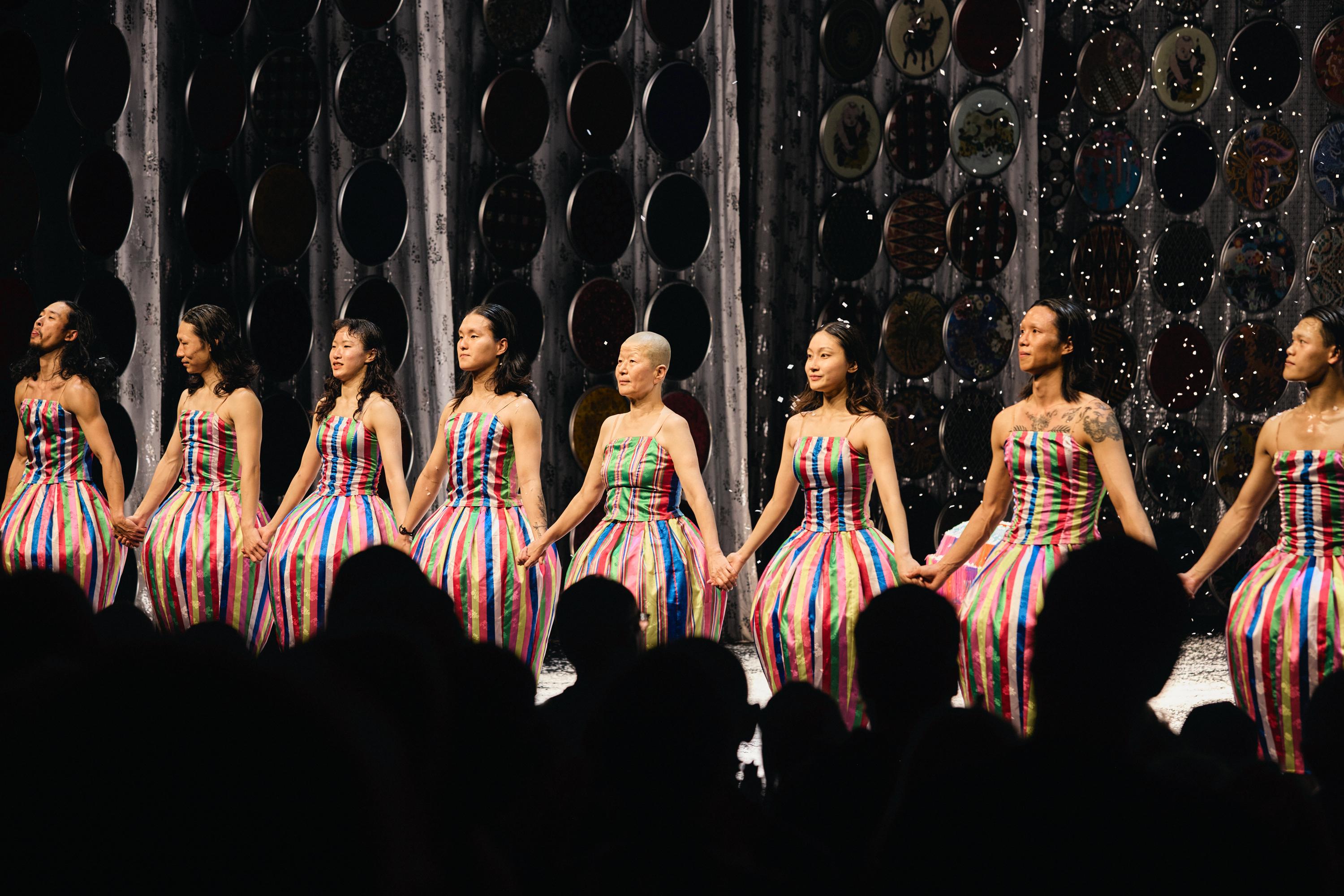
The full standing ovation at Berliner Festspiele for the European premiere of „Post-Orientalist Express“ by Eun-Me Ahn was immediate and sustained. The Korean and cosmopolitan choreographer, known for her unexpected yet captivating performances, once again conquered the audience with her unique charisma.
Nearly a century has passed since American dancer Ruth St. Denis draped herself in Asian costumes to interpret „the East“. In recent decades, Asia rapidly underwent modernization, often under Western discursive frameworks that flattened its complexity. But Orientalism — the practice of exoticizing and misrepresenting other cultures — was never only a Western habit. Within Asia, nations have long engaged in mutual friction and tension with each other. Over 80 minutes, Ahn with eight dancers from her Ensemble attempt to harness what she calls „inter-energy“ from an insider's perspective — an exploration of entirely new hybrid identities: What new imaginaries might emerge, when a Chinese blue-and-white ceramic teapot meets a Japanese paper umbrella, when skirt panels transform into water sleeves, when dancers invert themselves to use feet instead of arms? How can these rearrangements of cultural and bodily symbols spark fresh possibilities?
Before the performance begins, video samples of Orientalist clichés are played: historical dance footage, scenes from „The Adventures of Tintin“ involving China, generic „exotic“ imagery. They flash inside a small circle outlined in green — like the „accept call“ icon on a video chat app. We're all passengers on this train, invited into a conversation about how we see, and more importantly, how we misread — each other.
Cultural symbols reimagined
Ahn calls her approach „inter-Asian“ rather than „pan-Asian“. The difference matters. Pan-Asian suggests a false unity, as if all Asian cultures share the same values and histories. Inter-Asian acknowledges the real frictions, hierarchies, and misunderstandings between Asian nations — and treats those tensions as creative fuel rather than problems to solve.
A dancer in a massive white court crinoline skirt embroidered with a green peacock moves across the stage with quick steps, holding an oversized Chinese ceramic teapot with blue-and-white patterns, steam billowing from its spout. After slowly circling the stage, she arrives stage left, where the teapot is swapped for a white paper umbrella. From this moment, the music shifts and accelerats. With the drumbeats and fluorescent lighting changes, costumes grew increasingly extravagant: glittering fabrics, neon headdresses, multicoloured flower crowns — a signature display of Ahn's playful engagement with pop colors. The silver discs in the background begin projecting images — seated Buddhas flickering in and out of view. Friction is accumulating, tension rising. Tonight, cultural symbols become resources to be recombined, scrambled, and reimagined. Ahn promises no reconciliation or easy solidarity. She offers something harder and more honest: the chance to watch our bubbles collide, to feel the surface tension, and to recognize that friction itself is generative.
Inhabiting bubbles
As Ahn herself takes on the stage, dressed in black, embroidered with a golden dragon, approaches a wooden board and, with the precision of a taekwondo practitioner, smashes her forehead into it. A small red dot bloomes between her eyes. The music instantly flippes to a party beat, tension releases. Under the gaze of Buddha images, the previous tension begins transforming into energy.
In the finale, she returnes in a white dress inflated by hidden balloons. Against a backdrop of continuously falling paper — like cherry blossoms or snowflakes, she poppes the balloons hidden beneath her white dress. Each burst sharp, almost violent. The balloons represent the bubbles we all inhabit, the echo chambers of culture and language that insulate us from each other's worlds. When they burst, the sound is jarring. But the burst is also a release, a making-space for something new.
Living in a world of algorithmic acceleration and hardening borders, „Post-Orientalist Express“ offers a different possibility. It doesn't promise that we'll all understand each other or that cultural differences will dissolve. Instead, it suggests that the collisions — uncomfortable, messy, sometimes painful — can serve as a springboard for thinking.
For viewers navigating their own mixed identities — like myself, someone born and raised in a small Chinese city, educated under a British higher education curriculum, and living in Germany for twelve years — the work feels less like a performance and more like a journey awakening deep subconsciousness. We are all on Ahn's train, moving through a world where borders are supposed to be clear but never really are. The question isn't „Where do I belong?“. It's „What energy can I generate from the in-between spaces?“.
Noch keine Beiträge
basierend auf den Schlüsselwörtern
Bitte anmelden um Kommentare zu schreiben