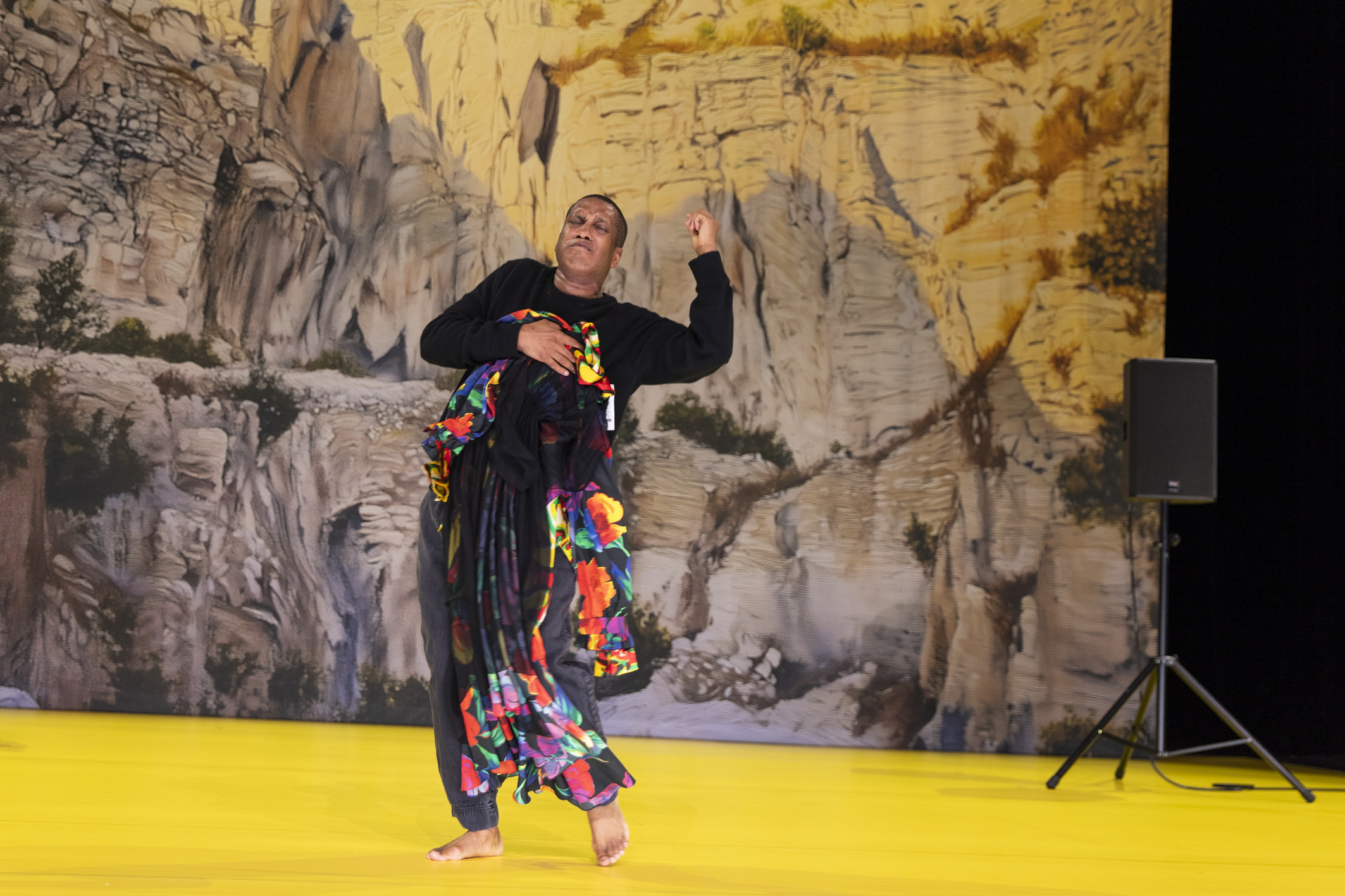
Trajal Harrell in „Music Music“

Only in his body

Trajal Harrell’s „Music Music“ at Tanz im August

Touring after Vienna and Avignon, Harrell brings his latest „what if“ question to HAU. This time he asks inward: his catalogue and his body of now.

Berlin, 24/08/2026

In the „before the stage“ session for Trajal Harrell’s „Music Music – Histoire(s) du Théâtre VII“, artistic director Ricardo Carmona shares that Harrell’s artistic motif has been building around the „what if…“ question, which sees history as a way to enliven the imagination. This is the seventh work in „Histoire(s) du Théâtre“, initiated by Milo Rau. After Vienna and Avignon, the piece comes to Tanz im August in Berlin.

Embody the music

In HAU1, the floor is vivid yellow, the backdrop a huge cliff at dusk. Under the house lights, Harrell enters in layered costumes, wigs, skirts and shirts stacked on top of one another. All music selected are from his previous choreographies in group works, but tonight he has to cross time alone.

He takes out a phone and plays a pre-record voice to tell us he lost his voice and asks us to play the song „Cold Heart“ by Elton John and Dua Lipa released in 2021. Depending on one’s internet speed and proficiency in operating a smartphone, the funky melody starts as a canon from different corners. He peels his clothes off until he is left in a black shirt, grey trousers and a pair of bright blue socks, then he begins to dance.

Soft and playful, he circles freely like a child resonating with the music. From Henry Purcell’s „Music for a While“ to Solange’s „Don't You Wait“, he slowly instills his own memories into the movement language. Time seems to shift from childhood to expressionism. You may recognize the piano stool on the stage from his well-known „The Köln Concert“. Harrell combines his commonly used materials for example voguing arms, catwalk, piles of clothes and Butoh facial expressions to create the sensual experiences. 

The transitions between tracks are clearly audible, his movement sometimes overlaps those same seams. At the end of an opera passage he raises his arms like a conductor. As the following notes swell from soft to loud, he only intensifies the same gesture, and both the music and the dance switch.

Near the end, Harrell’s body begins to tremble after two passages of dance in blue light, filled with misery and struggle. There is an aftershock, as if we had been carried somewhere.

Only in his body

I am willing to grant his sincerity and radiant charisma as an artist. It is an emotional journey and I can clearly feel the emotional flow, especially in the mini trembling at the end. 

But the content does not achieve what it promised as the beginning, what „Cold Heart“ conveys. „Cold Heart“ is not only Elton John reprising his four hits „Rocket Man“ (1972), „Where's the Shoorah“ (1976), „Kiss the Bride“ (1983) and „Sacrifice“ (1989). The collaborator Dua Lipa breaks in as another generation, gender and quality of charisma. Tenderness becomes shared recognition because an other is built into a new object. In comparison Harrell’s „Music Music“ does not weave such an other into its texture. Reworked from group choreography into a solo, the imaginary object remains in his body. Sitting in the theatre, I received something closer to a DJ mixtape performed with his own imaginary gaps.

A ritual within

From 2009 to 2017, Harrell challenged official dance history with the work series „Twenty Looks or Paris is Burning at The Judson Church“. In the 1960s, Harlem’s underground ballroom culture and Judson Church’s white minimalism were invented at the same time in New York, then split by the canon. Harrell asked: what if someone from the Harlem balls had come to Judson? Two incompatible things were made to interfere until what counts was rewritten. The imaginary object was public. That is the „what if“ Carmona named before the show.

By contrast, „Music Music“ keeps the phrase and changes the object. The encounter is between his catalogue and his body of now. Tonight’s „what if…“ no longer addresses someone written out of dance history, it addresses what only his kinesthesia still remembers. The effort is not built into a public object that can be seen or held onto in this room. Those who have not seen the earlier works largely have to stay close through their own kinesthesia. Watching a body know is not knowing.

The artistic note bills this solo as the end of one phase and the first work of a new, music-centred sequence. Does all this sound like a hello-and-goodbye ritual?

The harder question is who the ritual is for, especially at this festival scale.


Kommentare

Noch keine Beiträge

Ähnliche Artikel

basierend auf den Schlüsselwörtern