Wind in grünem Fell
„Trapicana“ eröffnet Tanz im August
In Berlin, the wind picks up after the heatwave has passed, hopefully the last round of this summer. People start wearing long sleeves and jackets. What a dry and hot summer in the last months! Here let us have some fresh air through three pieces from the second week at Tanz im August.
Air spreading
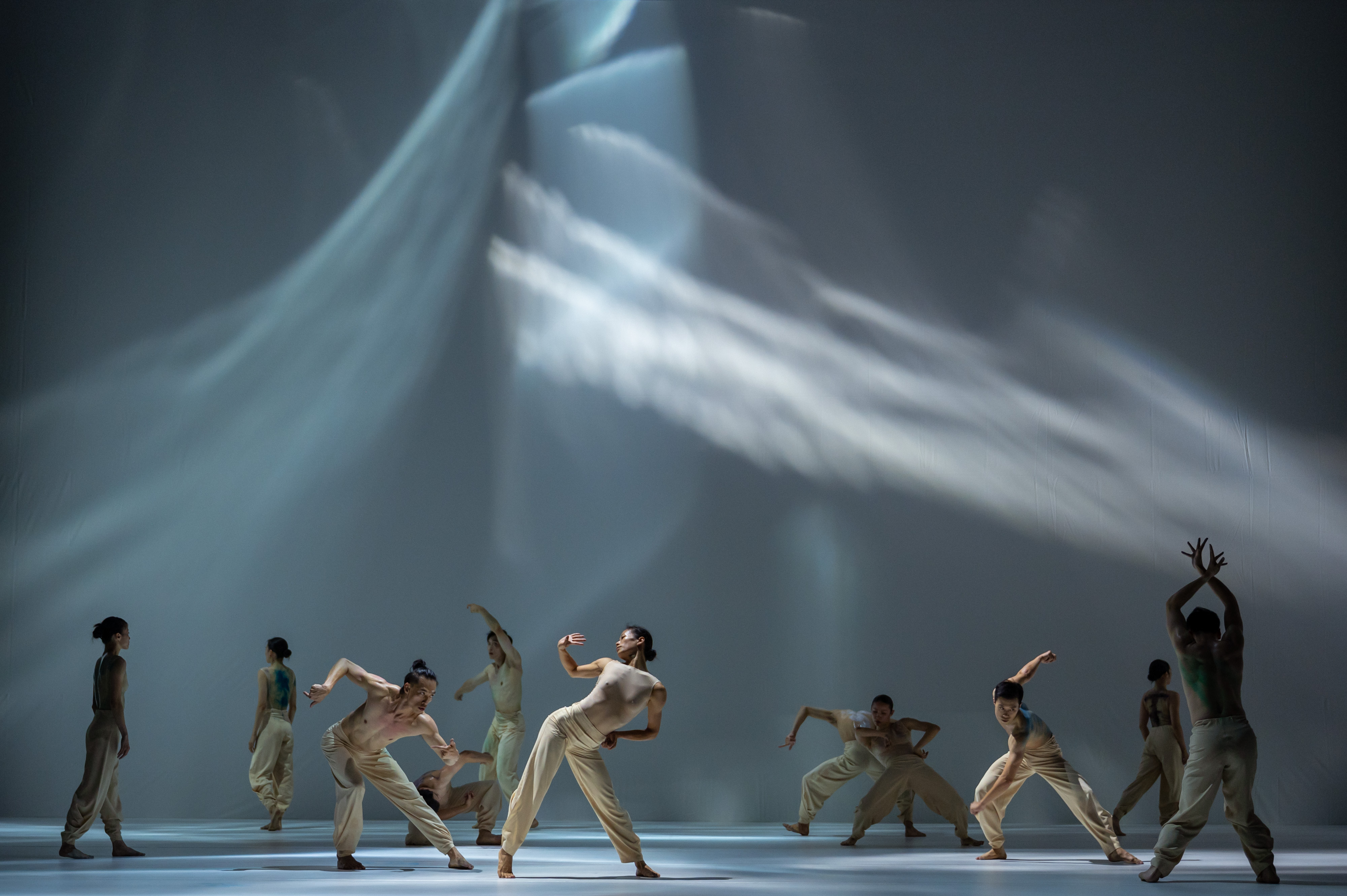
Tranquility, settled: the work „Sounding Light (定光)" from Cloud Gate Dance Theatre of Taiwan tunes the air in the space to a diffuse and mediative climate. Twelve dancers snap their fingers, click their tongues, clap their thighs and stamp the floors. There is no orchestra during the one-hour performance but the dancers are swiftly pressing the air in a natural way.
In Berliner Festspiele, on a full white stage with lights dimmed from above, dancers bend their bodies like a mountain range and then disperse into swaying groups. Composer Chang Shiuan does not speak the local Taiwanese Hokkien, yet sets reduplicative words on the musical notation. „Peh siak siak, ang ki ki, am mou mou, sui tang tang", so you hear whether rain falls in a gutter, a stream, or on a solid rock.
Through their bodies, a flowing picture of a mountain forest unfolds: birds, a burst of rain, a stream hitting stone. „Sounding Light" is Cheng Tsung-lung's first full length work after he became artistic director of Cloud Gate in 2020. In a local interview with LaVie, he explains that the title is traced to Dipankara Buddha, who radiated light at birth: „When voice and body become one, that is a person's brightest moment."
Forced into tubes
In „The Choreography of Water“ HAU3 is dark from the start. A beam of warm light hits an elegant, vertical glass fountain. Water travels through three pipes laid across the front stage, each connected to a glass cylinder. One performer starts to scrape the water inside. The acoustic experiment begins. Black, silver, shimmering are the visuals shared with glass, water and the costumes of three performers tonight.
Simona Deaconescu, Ioana Vreme Moser and Simina Oprescu ask: what would the future might look like if water was always co-choreographing? The material is there. A uterus-shaped glass sculpture. A double-mouthed sculpture that sounds by gravity. Three women who carry both instruments and choreography at once. A woman's body, water, nature under extraction: they might have travelled the same path.
In the first solo, mesh glitters in the dark. Arms wave and wrists circle, the body turns. The gesture and the shimmer recall „Jibaro" from the third season from „Love, Death and Robots": lake and jungle as a uterus, then colonial raid laid over the plunder of women.
But the experiment stays inside the laboratory. In the first minutes, before you can tell how the different sounds are made, which friction belongs to air and which to water, a backing track slides in and the distinctions blur. That differentiation was critical: once gone, the emotional architecture to be built later loses its footing. The performers, rotating between musician and dancer at the same time, offer no single body to follow. Therefore, water itself unfortunately moves more like an object being managed on stage. The concepts are still fragmentary and when the final image of pipes spreading across the full stage arrives, the image of circulation has not been earned.
CLAP & SLAP
In Radialsystem, Agnietė Lisičkinaitė and Igor Shugaleev are standing against a metal barricade like opposite sides of a ping-pong table. Downstage right, two small screens show their faces during a meal conversation. They chatted over the origin of their favorite potato pancakes. From dishes to origin, the conversation moves to nationality and identity. After a provocative question „Is it not the same thing, aren't you the same thing?", the piece begins.
Agnietė Lisičkinaitė is Lithuanian and Igor Shugaleev Belarusian. Palm pressing the air onto a body part, so simplistic is the gesture designed for the whole piece. Clapping and slapping, same movement but in different intentions.
A video recording of the dramaturgy Bush Hartshorn leads the audience to clap. The performers also step out of role to conduct us. Then the classic slap, through the air from the back of the head to the nape. In the artist talk, they mentioned the inspiration comes from the religious „mea culpa". On the stage, the pair recalls „Light/Dark" by Marina Abramović and Ulay. Two bodies face to face and they decide when to stop themselves. The second worth noticing is the audience in the seats. A moment ago, we were still clapping with the beat. When the performers turn to attacking each other, the applauding from the audience quickly stop. A few seconds remain of slapping above and applause below. Who we are when we are applauding? And for whom?
The work sets out from guilt and sadness after the war. It pushes Igor to ask himself, „Am I a good person?" just as any of us once did as children, splitting the world into heroes and villains. What is an individual’s share of a collective responsibility? In real life, Igor is in exile from his homeland carrying what he described as „disappearing identity". In the last scene, they stand face to face in the dark. Her voice carries the Lithuanian anthem, on the other side is a Belarusian rebel anthem which is currently illegal.
Small volume in the chest, peak pressure in the room. The air is still moving.
Noch keine Beiträge
basierend auf den Schlüsselwörtern
Bitte anmelden um Kommentare zu schreiben