Herzschläge und Herzflimmern
GöteborgOperans Danskompani beim Festival Steps mit Arbeiten von Sharon Eyal und dem Duo Tiffany Tregarthen & David Raymond
Who would have thought so? All it takes to escape the neverending razzle-dazzle of German trains with its more than just slightly derelict infrastructure is to cross the border. Once in the Netherlands, travelling couldn’t be smoother. Each and every single train takes you all the way to Belgium's capital just as scheduled. And Antwerp with its georgous architecture is so worth the trip.
Surprisingly, the opera building itself, flaunting a mix between beaux art and neo-baroque, is smaller than you would expect, and yet it sports no less than three balconies. For the last show of the season the staff hands out pink cardboard fans and free water to the audience, and for sure there doesn’t seem to be anyone who isn’t happy about that. There is some sort of ventilation system in the hall, but no full ac. Accordingly rumor has it, that during the day one of the female dancers collapsed and had to be replaced for the show.
So the audience oscillates between sympathy for the dancers because of the thankless grind they have to face and trying to keep up appearances themselves. In some way that matches the title of the evening: „Love & Loss“ joins three pieces, that somehow evoke a bittersweet emotion between a final goodbye and a deeply heartfelt relation between two people.
As a seemingly simple example for that „Mitten wir im Leben sind“ (2017) by Anne Teresa De Keersmaeker has two dancers, Philipe Lens and Lateef Williams, taping a star-shaped pattern on the stage floor, with one of the tips marking the spot for Maria Franz to place her cello. She plays Bach’s second cello suite and thereby spurs Williams to start a sensitive depiction of her music, later joined by Lens. Music and movement intertwine noticably, but by doing so do not seem to create much of their own. With a somewhat sad tune, Williams seems to be in mourning; a fast paced part has him move vividly. Despite all of the finetuning in emotional representation, the dance itself does not add as much of an additional layer as it could.
This sort of simplicity or even lack of complexity unfortunately pervades through Williams Forsythe’s magnificiant „Quintett“ (1993). The poignant atmosphere that’s so striking with this piece seems reduced to a jolly good time. It’s a good thing when the audience would love to join the party on stage, but considering Forsythe dedicated this piece to his wife who was dying of cancer back then, maybe it shouldn’t be this way. „Quintett“ has been interpreted by numerous ensembles around the world, and it is known that the complexity, the simultaneous elegiac grief and blissfull joy, is its actual challenge. Be it because of the heat, that night this interpretation isn’t quite up to par with what’s out there.
So in the end it’s the final piece, the premiere of „Only light years away“ by Tiffany Tregarthen and David Raymond, that reconciles the audience by literally dragging everyone into a dark hole. The Canadian choreografic duo also work as creative heads of their own company Out Innerspace Dance Theatre and have presented commissioned pieces in several theatres throughout Europe. Their approach is one of absurd dance theatre that fuses movement, experimental lighting and innovative video techniques.
Their hardly lit stage reveals (or rather doesn’t) a central, hollow mound that gives birth and devours humanlike creatures, while a screeching, eerie, siren-like sound torture’s everyone’s ears. Some time ago Tregarthen and Raymond have come up with a special way of projecting videos in a way that makes them seem threedimensional. Here they rely on black and white faces and hands, hovering above the creatures on the ground. These clearly have been guided by the two choreographers themselves, finally raising the dancers to just the level of interpretation the audience has been waiting for.
And with the merciless heat preventing everyone from getting even a little rest at night the ensemble moves on to Bruges for the very final performances of the season. Just like an ufo the red bricked facade of the concert hall sits at the brim of one of the most picturesque old cities in Europe. Concertgebouw, as the building is called in dutch, was opened in 2002, marking the beginning of Bruge’s „reign“ as cultural capital of Europe. To make sure traffic around the building and parking underneath does not interfere with the fine acoustics during a concert, the whole building is erected on thousands of steel springs. Inside, it seems to defy any logic or rather orderliness: As soon as you turn around any corner, you are not just met by a new, surprising architectural detail, but also by art. In one of the staircases several huge bells hang from the ceiling. At least bells they seem to be. As a matter of fact these are loudspeakers from a stadium in Prague of the soviet era. Putting them into a different sort of context changes the matter completely.
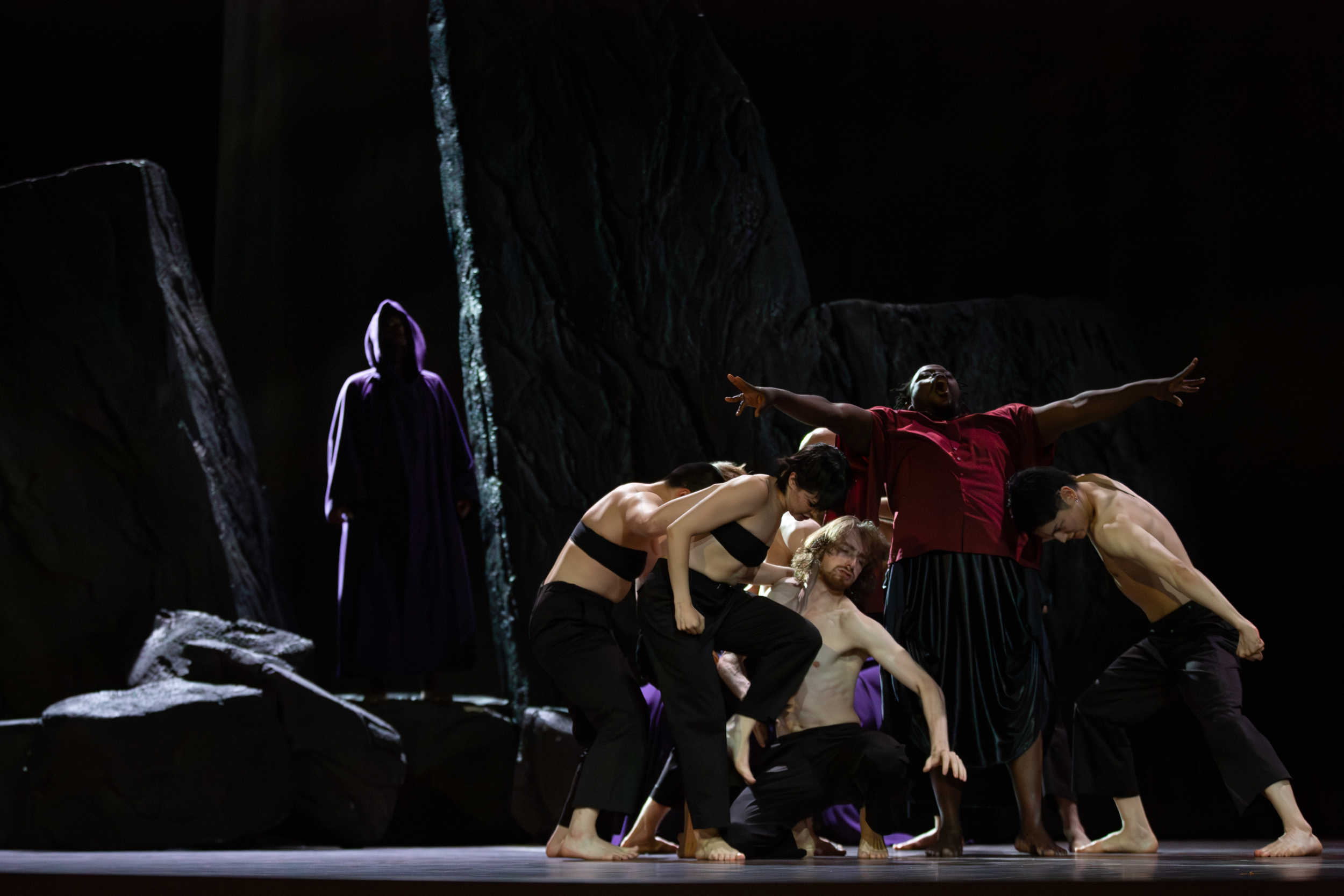
Basically that’s what Wim Vandekeybus does in his „Carmen“. The choreographer, known for his relentless, fierce style, directs his first opera, including the ballet ensemble. He has his staging start with a high, metallic clanking sound, right before the curtain rises. What might be some sort of innovative percussion turns out the chisseling of an anonymous group of people in long, hooded cloaks, hammering away at a massive dark wall. When they finally reach the breakthrough, the tumbling fragments give way to an opening that sets free a pack of half naked lunatics that are closer to animals than human beings. Their „leader“ (Horácia Macuacua) keeps producing revolting sounds.
What Vandekeybus presents here is nothing less than the setting free of everything evil, in a psychological sense, however. Henceforth these madmen will surround Carmen (Raehann Bryce-Davis) the way flies never seem to leave a cow. And in the end, when Don José (Joel Prieto) stabs Carmen, she is almost protected by the bodies of the pack, and their leader is the one who actually gets stabbed to death. Carmen walks away slowly and, with a final gesture of victory, she lifts both her arms as the curtain lowers.
Of course here Vandekeybus does not send the dancers roaring the way he does in his notorious pieces. Instead he interweaves them with the choir, generating an organic, larger group with particular details to keep an open eye for. Just like in a „find Waldo“ picture there are different, special characters, such as a seemingly queer man who repeatedly draws attention to his actions simply by doing „his own thing“. This overall complexity strengthens the psychological approach.
This is one of the biggest productions the house has ever seen. And it’s one that is worth the while. While so many productions simply „add“ choreography to an opera, here the interrelation supports the tragedy of Carmen’s death.
Noch keine Beiträge
basierend auf den Schlüsselwörtern
Bitte anmelden um Kommentare zu schreiben