Tschechow in Seile gepackt
„Sechs Schwestern“ von Lea Moro. Ein Fotoblog von Dieter Hartwig
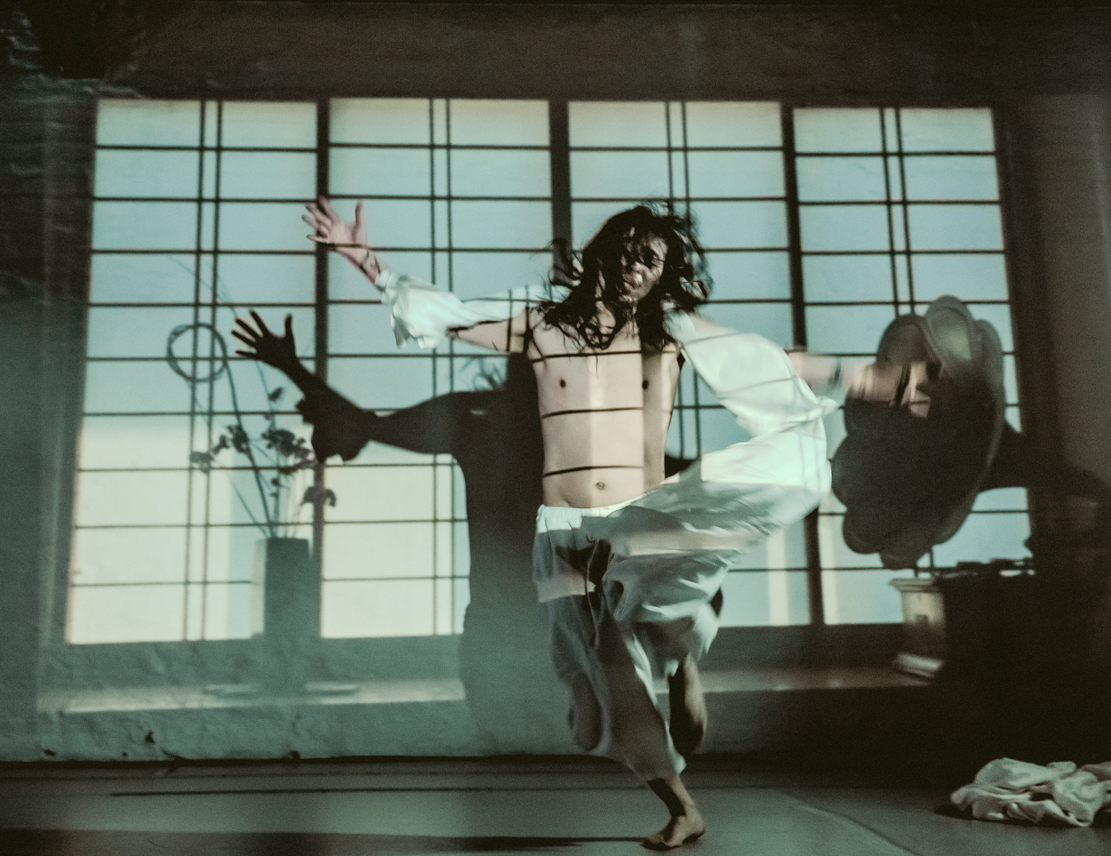
In the sunken space of Uferstudio 1, two dancers walk down the stairs one after another, one in black, one in white, leading us into a series of collective historical memories. „Ordinary“, a dance theater work created by Atsushi Takahashi and Tomoya Kawamura, poses the unsettling questions: What is the meaning of the ordinary to all of us? How do we know what we have before it disappears? Over 50 minutes, the performance moves through three historical ruptures, 1931, 1945 and 2011, constructing a space with traditional Noh aesthetics and contemporary dance where the boundary between the ordinary and its sudden annihilation can be reflected upon and seen. Through three acts presenting prophecy before disaster, experiences during catastrophe, and reconstruction after, this performance brings the necessary disturbance from past traumas to our present moment.
„I knew it. I thought I knew it.“ This poetic line describes an extremely fleeting yet constantly unraveling thought in face of sudden change, indicating that we are always retroactive to loss. Ordinary things in everyday life are fragile, finite, and they are what we stand to lose. Our body's knowledge arrives too late.
Both artists bring deeply personal histories to the work. Kawamura, trained in Kabuki and Noh, has spent years excavating difficult Japanese memories. This is his latest work after the oral history storytelling piece „Letters from Chiran“. Takahashi connects this work to his 14 years of dedication to community rebuilding in the aftermath of the 2011 Great East Japan Earthquake. He traveled immediately to the disaster zones and spent years organizing music events as spaces for prayer, mourning, and communal resilience.
Visually, the two create a study in contrasts. Takahashi moves with free limbs driven by inner thoughts and feelings, with explosive energy. Kawamura operates with Noh's contained precision. Stillness as intensity, minimalism as abundance. Both dancers' costumes retain elements of Japanese tradition, incorporating soft, constantly flowing scarf fabrics. Lighting and projection further amplify and blend the boundary between black and white.
The Train That Never Stops
The work traverses three historical moments. 1931. At its heart is the poem Erich Kästner wrote on the eve of Nazi power, imagining history as a railway journey with no destination. We pack and unpack, seeking meaning but finding none. Stations are announced, but the train never arrives. Then, without warning, the whistle shrieks. The train stops. The dead disembark. The dead stand silent on the „platform of the past“, left behind as the train drives forward. No one knows why. The living continue, not by choice, but because the train does not stop for grief.
1945 Hiroshima, a masked figure stands motionless as a survivor's recorded testimony plays. The mask remains ambiguous. Is the figure speaking or listening? In the face of human-caused disaster, speech and listening collapse into each other.
By 2011, the tsunami scene arrives with the deep sound of ocean waves. Takahashi dances with his eyes closed, in other words, with an interior vision. Behind him, his photographs project: candles, stranded boats, sotoba next to graves. For Takahashi, dance has become a form of care.
Power for Lives
After the chaos of overlapping projections and the Buddhist concept of shura (conflict, suffering, ceaseless agitation), the stage empties. Kawamura stands still, removes his mask and starts to speak. He describes losing someone important. In a poetic voice, the dead become stars that are luminous, distant and visible.
No matter which corner of the world we come from, we resonate with it deeply. There are two stars in my night sky, but some of their habits from their lives, have already merged into my daily life. As I look up at the night sky, perhaps I need them more than they need me?
This reminds me of a review I read years ago about the Japanese film „Departures“ (2008) directed by Yojiro Takita. Though it appears to discuss death and separation, it actually explores how to live well. Death serves life. As Confucius says in the „Analects“: „If we do not yet understand life, how can we understand death?“ It is the capacity to notice, to care, to remain present to experience even when that experience includes loss.
This reframes Takahashi's movements. He dances not only for the passed but for the living who must continue. If we can first understand how to live, how to be present to the ordinary in its fragility, then perhaps we earn the right to speak of death.
When the projection shifts to Kawamura's hometown, we again see the textures of daily life, flowing, collective, and intimate. Ordinary proposes that slowness creates the pause necessary for noticing. If we move too fast, we might miss what makes life more than survival.
Echoing the opening, the soundscape ends again with Takahashi's own amplified heartbeat. The heartbeat is the most fundamental rhythm of life, marking time from birth to death.
Noch keine Beiträge
basierend auf den Schlüsselwörtern
Bitte anmelden um Kommentare zu schreiben