Schamanistische Fingerübung
„Product of other circumstances” von Xavier Le Roy im Haus der Kulturen der Welt
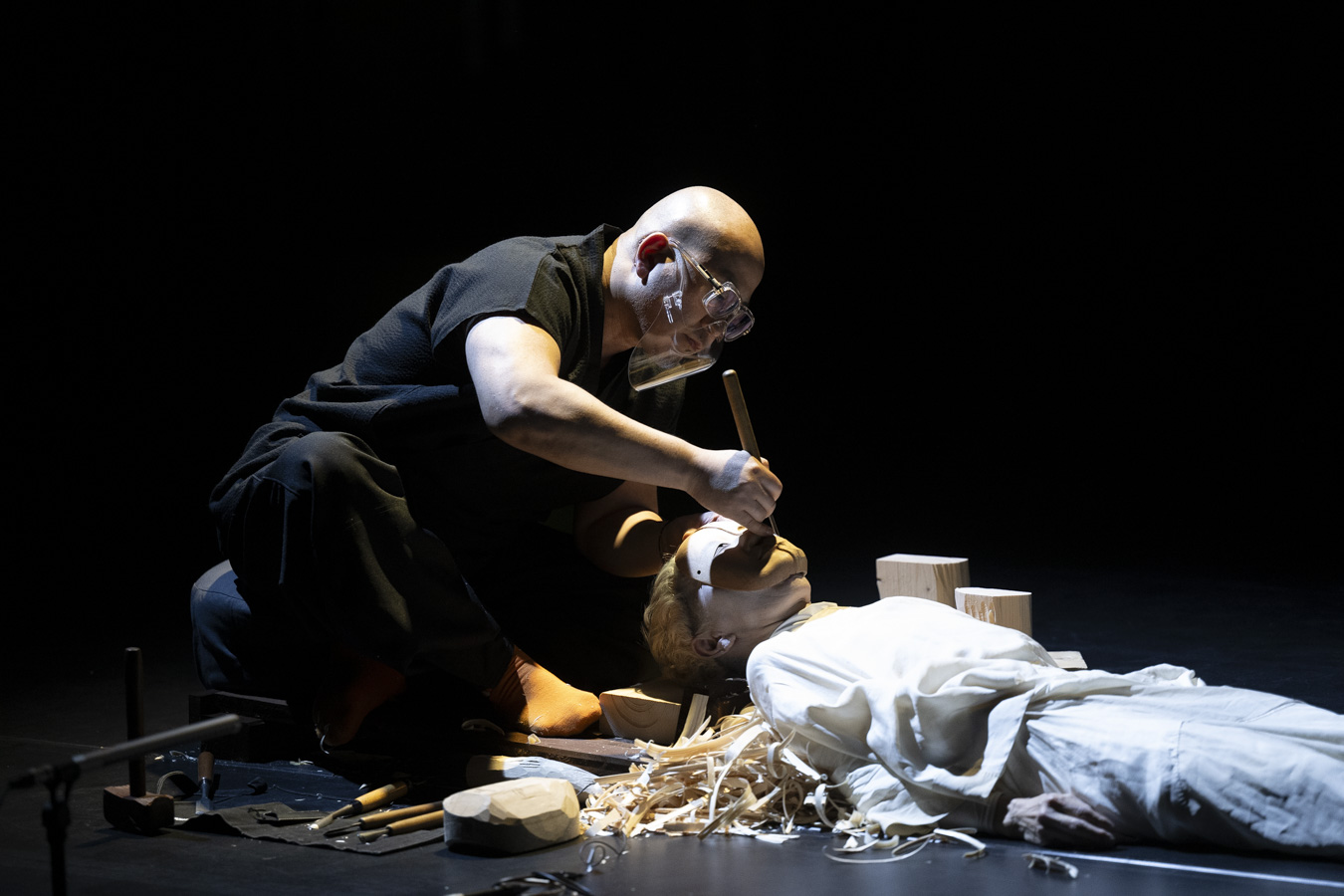
“NO-MEN 能面 – Severance | Dead Data | Raw Skin“ at Haus der Kulturen der Welt in Berlin
離見の見(Riken no Ken)
Originated from Zeami, „離見の見“ is the performance philosophy which proposes the necessity of observing oneself from a distance, with objectivity. On stage, the performer’s gaze turns into a bird, hovering above the audience and trying to understand the relationship between the self and the entire space.
Before the performance begins, hundreds of spectators are already waiting outside of the Miriam Makeba Auditorium of Haus der Kulturen der Welt in the spring evening. Yuko Kaseki dressed in white, walks slowly through the crowd, wearing a traditional Nō mask with an almond-eyed smile at the back of her head.
As the doors open, the crowd parts to leave a central aisle. Like a wandering monk, Yuko transforms the aisle into the bridge of Nō theatre, making her way towards the stage, where a rectangular mirror stands. On either side, there are the Nō mask master Bidou Yamaguchi and musician Mieko Suzuki. From stage left, a steady knocking and scraping of wood simulates the ticking of a clock while from stage right, Mieko Suzuki's textured, drone-like sound opens another timeless, imaginative soundscape.
The audience needs to quietly find their own place during the first few minutes. Which side are you looking at? In silence, the audience watches how Yuko’s consciousness moves around her own body, standing in front of a mirror and imagining how it might be perceived from the seats beyond. She raises her own left hand, which is the right hand of the masked figure on her back. Through the mirror, the audience receives both the movement of Yuko's body and the masked figure's movement simultaneously.
„NO-MEN 能面 Severance | Dead Data | Raw Skin“ is an audiovisual performance presented at HKW as part of the series „AI (Ancestral Immediacies): Digital Twins and Data Doppelgängers“. The digital twin, chatbots, or any AI-generated form, can imitate and rehearse a pattern through massive dataset training. However, the accumulation doesn’t rely on experiences and is carved by no passage of time. When something that resembles a human has never lived a human life, what exactly is it? Can it, like a bird in the sky, attain the perspective of „Riken no Ken“?
Interiority
In Shintō tradition, the soul enters through confrontation and emptying of the self. Yuko gazes into the mirror, to recognize and pursue another image. The mirror, functioning as an instrument of self-dissolution, turns the body into a vessel capable of traveling across time.
It is sacred to breathe and to see: Yuko is dressed entirely in a wide, white robe. One sleeve is slightly longer than the other. Her silver-grey hair, parted at the crown, seems to divide her own self from the mask into two individual presences. Her gaze is distant, her rhythm unhurried. The shifting light extends the mirror's reflections all the way to the ceiling, shadows swaying in gold and amber light, natural and fluid.
In the second act, the mask becomes an object attached to a metal tube. The second mask has its eyes closed and expression severe, carrying a metallic coldness. The mirror rotates ninety degrees, dividing the stage into two halves. Yuko places the mask on the same side as the face, plays with the reflected image, shifting it from left to right.
The body and the mask instrument drive each other. The body pursues, falls, and must find balance. The soundscape that Mieko Suzuki constructs is itself a kind of dance: as the dancer's rhythm shifts, so does the tension in Mieko's limbs. Crackling, granular noise like the discharge of electrical circuits sets itself against the sound of wood shavings falling from Bidou's chisel, each side voicing in contrast but also mirroring its way toward harmony.
Bidou Yamaguchi's wooden mask blank is now complete. On stage, a new ritual of soul-transference begins. Yuko offers up the mask with both hands, then lies down fully, with her head positioned before him. The unfinished wooden mask is placed upon her face, adjusted in small increments over several minutes. This body of flesh, shed of its middle robe, begins to move, mechanically, in raw skin. For the first time in the entire performance, this body reaches out and touches the mirror, like a newborn encountering its own reflection for the first time. It cannot recognize itself. Can it be called alive?
Unfinished mask
Since the advent of ChatGPT, the invented “human-simulating” interaction style has vastly accelerated the learning and development of AI. Despite its novelty, the sycophantic tendency underlying its design often gets underestimated. Distilled from one’s own data, digital double often reinforces one’s own patterns, functioning not as a portal but as a sealed mirror.
On this evening’s stage, the unfinished mask has just been carved and not yet fully formed. How will this unfinished mask dance with humankind in the future? If people were to gaze upon their own digital doubles within some sustained, deliberate framework for years, would it begin to accumulate something that functions, in its own way, as a soul?
Noch keine Beiträge
basierend auf den Schlüsselwörtern
Bitte anmelden um Kommentare zu schreiben