Marathon of Perseverance
„Sweat (anthem)“ by Milla Koistinen & Dance On Ensemble at Tanzfabrik Berlin Bühne
300 minutes from the closing night of Tanzfabrik Berlin Bühne's project RESIST!
In full formal business code, Jasna climbs on a stack of books. High enough that balance demands her concentration, professional-looking enough to make you detach from the theatrical scene for a moment. Moving with more patience than you expect, she retrieves her reading glasses from her breast pocket, kneels to take her speech notes from the top book. English, French, German voices rotate in manifesto tone, calling for political mobilisation for the dance profession on this unstable ground. The A5 sheet folds and folds, eaten and spat back out.
„Stress ohne Grund“ kicks in. She jumps down, packs up books and spins through the space. A fairy girl in a full white lace dress glides in at a different speed on her roller skates. So playful, so deliberately anti-serious. A pure camp moment filled the space with audience’s laughter and ovation. As Susan Sontag wrote in „Notes on Camp", things are campy not when they grow old, but when we become less involved in them, and can enjoy, instead of be frustrated by, the failure of the attempt.
„The Speech“ by Jasna L. Vinovrški is one of seven works presented on the closing night of Tanzfabrik Berlin Bühne's RESIST! Project. While most responses to Berlin's current cultural funding cuts have been, in some way, about the cuts, RESIST! offered thirteen artists two and a half months of studio time without performance obligation. By temporarily removing pressure, a different quality of presence emerges. There is a particular kind of energy in the room, not loud, but accumulated, like the way a tide carries the force of its withdrawal.
Sounds, wounds and the city
Resistance is about power distance. In „Bying Time“ July Weber places an electric guitar and the body in equal negotiation on their own frequencies, presenting how one triggers the other. Resistance could also be visible through embodied relation and singing. Tatiana Mejia and her performers guided by clave, the rhythmic foundation of Afro music, pull, wrap, stretch and entangle the elastic bands to their limits in “Jaleo (AT_wt)”. Physically, bodies can absorb tension, transforming but still holding their character.
Christina Ciupke appears naked, arms painted blue. She broke them during a practice accident, not as metaphor but as fact. Moving limbs are floating with her contemplation. A short period of pure dependency on others can change one’s inner world rapidly. The constant „resist of missing out, useless thoughts, self-pity, dark clouds, no-future scenarios“, named one after another. I once injured my ankle, therefore I could feel how such deep vulnerability unlocks a profound destination of, in her words, „love, trust and tenderness“.
Other wounds are inevitable and cut deeper. Sergiu Matis’ kinetophoria derives from a particular moment at a funeral. Can one process grief in a de-compositional way? Dancing with his back touching the ground, isn’t it both the starting and ending position concluding one’s life?
Wedding, Berlin. Johanna Ryynänen and Thiago Rosa have been walking through neighbourhoods and collecting field recordings as a live journal. Where the audio shows the most void feelings, movement sharpens and accelerates toward the exit.
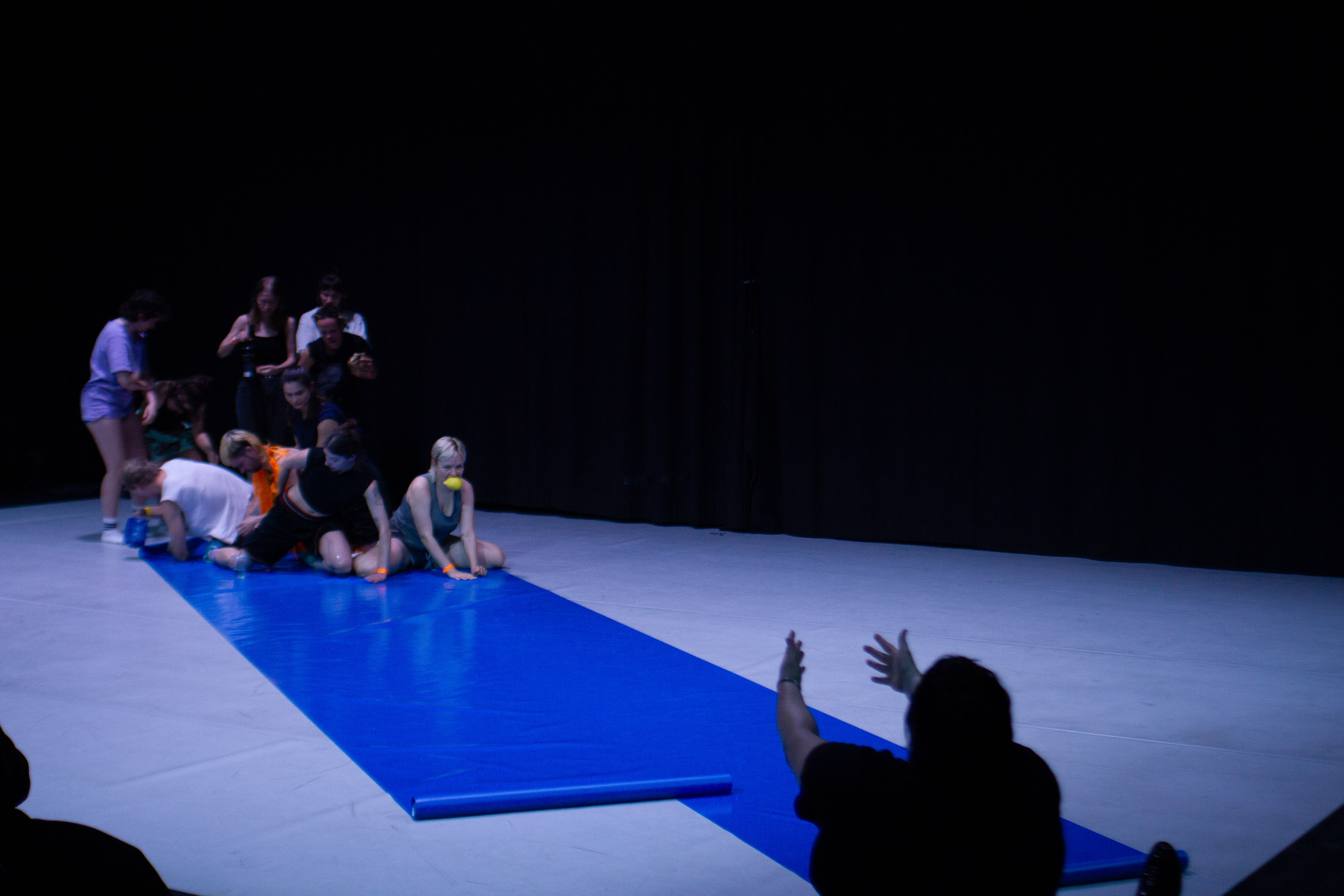
Beginning with her poetic text on building a new city, Jen Rosenblit closes the evening proper with „Conducting Oceans“. Ten performers move across blue rubber mats laid diagonally across the floor. The togetherness of the group is not conventionally harmony but held through drama and mischief. Simply this unstable ground, which is all they have, and which they have agreed to share.
Dialogue in present, off-line time
That daring to meet the people you don’t know before and generating a genuine curiosity about others through communication is probably a crucial capability of our age.
Bárbara Santos, director of KURINGA Theater Berlin, receives questions from audience who are genuinely cares about art: How do we see elite bubbles shaping Berlin's dance scene? How do you measure a success story in art? What's the difference between disillusion and imagination?
Given the time genuinely given artists are trusted to go deeper into their own practice. Into the body, into the city, into language and into communal form, they maintain the core capability of producing the real thing.
Noch keine Beiträge
basierend auf den Schlüsselwörtern
Bitte anmelden um Kommentare zu schreiben